10-year implant-level survival in a 2019 meta-analysis of longitudinal studies
Howe et al., Journal of Dentistry, 2019 (PubMed 30904559)
A regional Ukrainian clinic that has run since 1999 reports a volume ledger. Over its life: more than 10,000 clinical cases. In a single measured year: 910 orthopedic cases, 125 full-arch rehabilitations on six implants, and 604 professional hygiene visits. None of those counts is an independent survival study. What the open literature supplies through linked primary sources is a set of industry anchors. About 96.4% implant-level survival at ten years in a 2019 meta-analysis. Roughly 98.7% five-year implant-level cumulative survival in the six-implant group of a large retrospective full-arch treatment cohort. The useful comparison is not “this clinic beats the literature.” It is “here is what one Ternopil practice reports for throughput, and here is what published cohorts report for durability.”
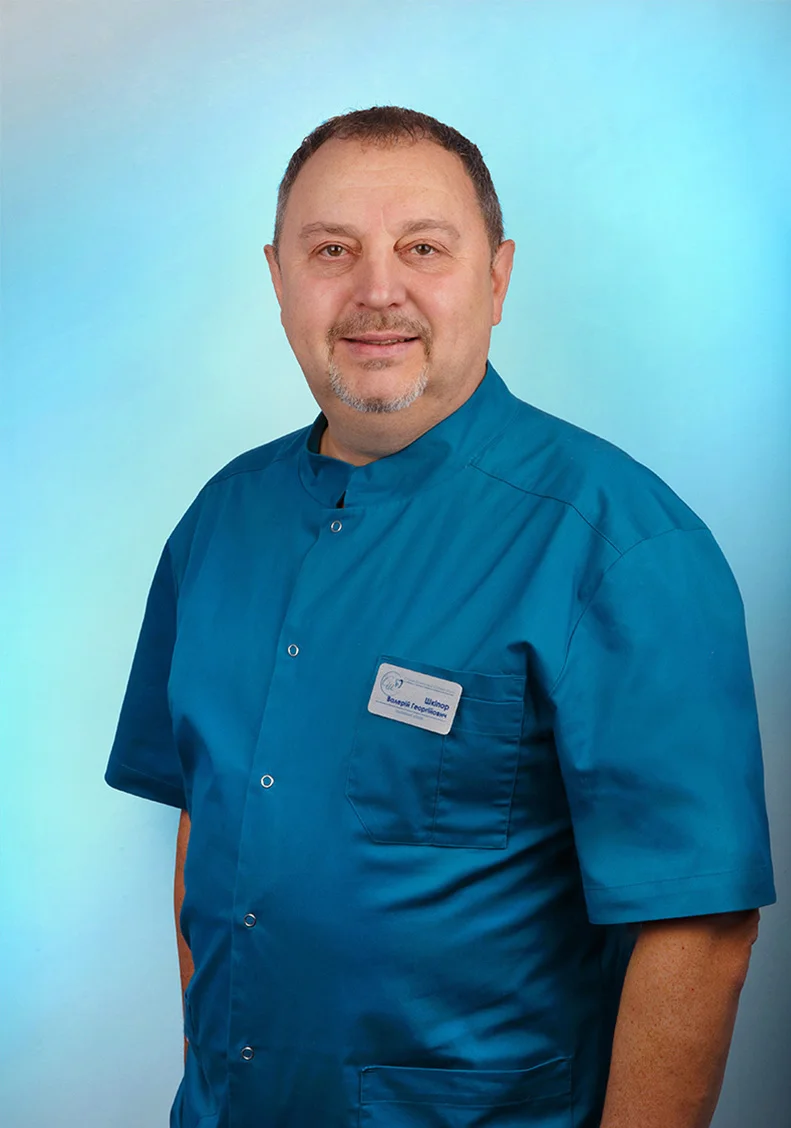
Those practice figures come from Valeriy Shkipor, founder and chief physician of the Studio of Aesthetic Dentistry in Ternopil. He attributes the operational counts to the clinic CRM ClinicCards and presents them as clinic data, not as a peer-reviewed cohort.
What the clinic reports for one operating year
For the window 1 July 2025 to 1 July 2026, the practice states an average ticket for the chief physician of 6,879.54 UAH and 910 completed orthopedic cases. Over the same months it logs 2,546.45 clinic hours and 604 professional hygiene visits. Separately, for calendar year 2025, Shkipor reports 422 orthopedic cases completed by him personally, 257 positive patient reviews attributed to that work, and 109 first-time consultations he conducted himself. The same submission puts the clinic above 10,000 completed clinical cases since its 1999 founding, with the founder describing more than 30 years in the chair. All of the volume numbers above are clinic-reported.
Full-arch protocol: six implants, twelve teeth, local price bands
On the full-arch side, the practice describes its protocol with six dental implants in one jaw as restoring the function and appearance of twelve teeth. For the measured year it reports 125 successful cases under that approach. The practice-stated fee floor is “from 2,500 euros.” Separately from the questionnaire, the clinic website publishes starting prices for related packages: “All-on-4” from 139,180 UAH and “All-on-6” from 167,100 UAH. Those are commercial price bands on a live page, not outcome statistics. They matter here only as a published local cost reference next to the case count.
| Metric | Clinic-reported figure | Independent benchmark | Status |
|---|---|---|---|
| Clinic age | Founded 1999 (~27 years by 2026) | n/a (local fact) | Clinic site + arithmetic |
| Lifetime clinical cases | 10,000+ | No independent audit found | Clinic-reported data |
| Orthopedic cases, 01.07.2025 to 01.07.2026 | 910 | No independent comparator used | Clinic-reported data (ClinicCards) |
| Professional hygiene visits, same window | 604 | Fair vs good hygiene: pooled OR 2.04; poor vs good: 5.01 | Clinic count vs Lertpimonchai 2017 meta-analysis |
| Full-arch on 6 implants, same window | 125 successful cases (clinic wording) | 5-year implant-level CSR in six-implant IFCD group: 98.7% | Volume vs published survival, not the same study |
| Chief-physician average ticket, same window | 6,879.54 UAH | n/a | Clinic-reported data |
| Public All-on-6 package from (site) | from 167,100 UAH | n/a | Public price list |
| Implant survival, 10 years (implant level) | Not found in reviewed clinic materials as Kaplan-Meier | 96.4% (95% CI 95.2 to 97.5%) | Howe et al. 2019 meta-analysis |
| Long-horizon survival mean, follow-up ≥10 y | Not found in reviewed clinic materials | ~94.6% cumulative mean (mean follow-up 13.4 y) | Moraschini et al. 2015 review |
| Full-arch 5-year implant-level CSR, 4 vs 6 implants | Not found in reviewed clinic materials | 98.4% (4) vs 98.7% (6) | Carames et al. 2025, 943 patients / 5,989 implants |
What the independent numbers actually measure
Howe and colleagues, in a 2019 systematic review and meta-analysis in the Journal of Dentistry, reported a main 10-year survival estimate at the implant level of 96.4%. The 95% confidence interval ran from 95.2% to 97.5% across 18 eligible studies. The paper also reports a separate sensitivity estimate; 96.4% is not that sensitivity result. An earlier systematic review by Moraschini and colleagues covered longitudinal work with at least ten years of follow-up. It reported a cumulative mean survival near 94.6% at a mean follow-up of 13.4 years across thousands of implants. Neither paper is about Ternopil. Both concern study populations observed for a decade or more.
For full-arch fixed complete dentures specifically, Carames and colleagues (Journal of Clinical Medicine, 2025) retrospectively analysed 943 patients and 5,989 implants in a controlled treatment cohort. Five-year cumulative implant survival was 98.4% in the four-implant group and 98.7% in the six-implant group, with no statistically significant overall difference. That is the closest large, recent public comparator used here for the six-implant full-arch protocol the Ternopil practice describes. It is still a different country, a different selection pipeline, and an implant-survival endpoint the Ternopil ledger does not publish in the same form.
Hygiene volume as a second axis
The 604 professional hygiene visits in one year are a process metric, not a disease outcome. A meta-analysis by Lertpimonchai and colleagues (2017) is the external reference used here. Compared with good hygiene, fair hygiene was associated with pooled odds of periodontitis of 2.04. Poor hygiene was associated with pooled odds of 5.01. These are associations from observational studies, not proof that the hygiene category caused periodontitis. The clinic’s count shows how often patients entered a hygiene chair. It does not measure how many avoided periodontitis. Placing the figures in one table is deliberate: one is local throughput, the other is association literature, and they answer different questions.
How to read the comparison without overclaiming
Three separations keep the table honest. First, clinic volume is not clinic survival: 125 “successful” full-arch cases is a practice label for completed work in a year, not a Kaplan-Meier curve. Second, price is not prognosis: the 2,500-euro floor and the site’s hryvnia packages describe cost, not durability. Third, industry survival figures are estimates from published study populations and cannot be transferred to any named patient. Where a number is a literature estimate, it is labelled as such. Where a number is attributed to a ClinicCards export, it is labelled as clinic-reported data. Datum’s job is to keep those labels on the same row as the figure.
Methodology
- Sources
- Practice metrics: questionnaire answers attributed to Valeriy Shkipor (ClinicCards CRM). Public-site checks: the clinic home page for its founding and profile, and its public price list. Industry anchors: Howe et al., J Dent 2019, PubMed 30904559; Moraschini et al. 2015, PubMed 25467739; Carames et al., J Clin Med 2025, PMC12194759; Lertpimonchai et al. 2017, PMC5724709.
- Scope limits
- No independent audit of the clinic CRM was available. Lifetime case totals and “successful case” wording are clinic-defined. Survival benchmarks come from external study populations and must not be read as the clinic’s own longitudinal results. Prices change; site figures were captured 2026-07-30.
- Updates
- Revised when the clinic publishes audited outcome series or when major survival meta-analyses update the 10-year and full-arch anchors. Corrections follow the site corrections policy.